Showing posts with label Homoerotica. Show all posts

Sunday, June 5, 2022

Alain Delon And The Homosexual Gaze


 "So what's wrong if I had? Or I did? Would I be guilty of something? If I like it I'll do it. We have a great actor in France named Michel Simon and Michel Simon said once, "If you like your goat, make love with your goat." But the only matter is to love." 


Alain Delon, on his alleged homosexual tastes (1969)


    And that's where M. Delon should have left it...in the full knowledge that actors' 'truths' about themselves are often to be taken with the same grain of salt as speculation about their sexuality. But he didn't. With his more recent dotage he's become the proverbial whore in church spouting homophobia while writing fluffy books about the women he's loved. His claim to not be bothered about being wrong can be interpreted as evolved masculinity or next-level narcissism. Richly deserving of the 2019 Cannes Palme d'Or d'Honneur for his body of work, it's hard to argue that he didn't also earn some of the backlash and personal denouncements his award attracted. It was full-circle for Alain Delon: he'd first shown up at Cannes in 1956 as the escort of an older actress, rather than as an actor. According to Roger Ebert he nevertheless walked the red carpet with gay star (and lifelong friend) Jean-Claude Brialy. 


A Real Piece Of Work


    Even as his millions of fans have tacitly accepted every salacious and unsavory aspect of his life, so they've accepted many probable dalliances with men - be they for love or personal advancement. Or as Claudia Cardinale put it: "Alain Delon? Men and women were lining up to have sex with him." But no amount of vilification or self-promotion can ever destroy or create the work of art that simply is. Delon's on-screen magnetism was summed-up many moons ago with a simple and succinct comment: "You just didn't know whether he intended to kiss you or kill you."


An enfant terrible from the get-go, Alain Delon's movie 
stardom arrived within a few years of his being dishonorably discharged from the French Navy while spending undocumented times as a Pigalle denizen - no place in the late '50s for a young fella to be avoiding crime and whoring. Four film roles quickly came his way, and few failed to notice that his blazing male beauty heralded future stardom as a new kind of movie Frenchman: young, immaculately composed and New Wave cool. He also personified the masculinity and sexuality which many Anglo males still despise as being of Frenchmen. If ever a man was therefore entitled to The Homosexual Gaze it was, and is, Alain Delon because his appeal lies squarely on the spectrum as carnal significance in top gear: he's a fine piece of ass.
 
 
Despite half a century of concerted hetero-washing and gun-as-penis stylized menace, there's nothing more obvious than the fact that the Delon image has its genesis in not-too-subtle homoerotica, and that the homosexual gaze polished it and continues to do so. French cinema in the wake of Alain Delon demands of male stars his unisex appeal and committed onscreen intensity. As with Delon, Romain Duris' identifiable gait commands attention in a long shot and the late Gaspard Ulliel brought Delon's acting chops as well as his male model sexual sensibility during his all-to-short life. For the French, it's de rigueur to do gay roles and do them frankly and arrestingly. As of course to hope they'll invoke the allure of Alain Delon.


The Style And Substance Of Homoerotica


When nobody else finds you attractive or desirable


    No amount of lived experience as a unisex object of desire could prepare Alain Delon for René Clément's Plein Soleil / Purple Noon (1960). The lead role in the first filming of "The Talented Mister Ripley" required acting skills far beyond what excellent direction could declare as believable. At twenty-four, Delon delivered a bullseye performance as the otherworldly Tom Ripley - seamlessly demonstrating pathos, menace and sexual ambiguity of the mostly creepy kind. A risky role, it fell to the amorphous quality of star power to succeed. The camera sent Alain Delon directly to the imaginations of audiences - any and all disparate gazes perceived exactly what their psyches craved. As we swoon we ignore the fact that nobody in the film finds Tom Ripley particularly attractive.

Originally up for the much easier second male role of the cruelly masculine Phillipe, Delon coveted the lead and his pitch to Clément and the producers (who humiliated him as "a little prick who should pay to be in the film") was that he shared Ripley's character. Watching Alain Delon in Plein Soleil does little to support any counter-arguments.


The role also demanded style, which Delon expertly served up as suave stardom, rather than something of an actor in good wardrobe. Well into the 21st Century, men's fashion writers globally invoke Delon as Ripley to demonstrate what style is, as they peddle expensive retro-ish fashion to men pursuing the myth of the alpha male with no regard for the amusing sidebar fact that they're being urged to impersonate an impersonator.

Commerce sometimes picks up on good ideas, and French style done properly gives a man an enigmatically attractive edge when being like him and being with him become blurred as sublimated homoerotic feelings. Of course, there would be no more aggressive salesman of Alain Delon Style than Alain Delon himself, as he merchandised as many aspects and accoutrements of his potent youth as possible through an endlessly extended middle-age.


A Piece Of Work In Progress: The Visconti Factor


    The homosexual gaze as passively experienced is one thing. The homosexual gaze as artistic inspiration and motivation is something else again, with few willing to acknowledge that some of the greatest art of Western civilization is the creation of homosexual men. Or that it was so before the term was even invented and pathologized. Luchino Visconti didn't make gay movies per se - the highly-educated aristocrat's cinema is as obtuse as it is rich in its social commentary while appearing unconfined to stylistic considerations.


Neither dissolute playboy nor self-absorbed trained actor waiting for breaks, Alain Delon immediately grasped all that cinema is, and set about being a great star actor within the collaborative process. His appetite and respect for great direction paved the way for what he had to be and do when chosen by Luchino Visconti as the titular lead in Rocco e i suoi fratelli / Rocco And His Brothers (1960). While Plein Soleil went a long way to establishing the Delon stereotype, Rocco as conceived by Visconti is an allegorical opposite. He's arguably the most womanly manly male ever to grace a cinema screen. While he could box with the best of them, Rocco's saintlike character is entirely of female components like tenderness, loyalty, protection, sentiment and sacrifice. Visconti clued us up early in the piece by sending Rocco out in the cold to happily do labor in his mother's sweater.

 
Taking direction or asserting intimate territory?
   While Rocco's 'sweetness' throws most critics to this day, it only makes sense to see him as the compleat male lover, as defined by an intelligent director who valued womanhood as much as he cherished masculinity. And it's just as reasonable to assume that the actor became what he played in some form or another.
   
People still speculate as to whether or not Delon took on Visconti as his lover - or vice versa - at this point. Interestingly, the morality of the place and time simply accepted the term 'protege' for all it implied. Candid on-set photos certainly indicate an unusual intimacy between an intimidating director and an up-and-coming actor.


   The Visconti / Delon relationship didn't end when 'Rocco' wrapped: within the year, Visconti decided to direct Delon and Delon's then-girlfriend on stage in his adaption of the scandalous Tis Pity She's A Whore. Neither had any stage acting experience, but Alain Delon had the experience of working Visconti's way i.e. he ran his sets as precise and disciplined stagecraft, permitting no improvisation. The Parisian critics  snorted disdain while the public and Delon in Elizabethan tights made it a huge success. As with the filming of Rocco, Visconti fussed with Delon's makeup while simultaneously applying his imposing stage skills to driving the theatrical event. All in all, it can't be assumed that Visconti took upon himself the sad role of an older gay man longing chastely for the unattainable - that's just the plot of  Visconti's Death In Venice (1971).


No faked period makeup for Tancredi
   Luchino Visconti was already rewriting and preparing to direct Il Gattopardo / The Leopard: an international big-budget adaption of the popular Italian historical novel, which as a film serves as a timeline precursor to Novecento/'1900' (1976), with Burt Lancaster further linking the two. Although Warren Beatty was being heavily lobbied by financiers for the key second lead Tancredi, he unsurprisingly got nowhere near the role while Alain Delon and Visconti were whatever they were. Retrospectively deemed  a masterpiece, 'The Leopard' truly is great cinema and it's difficult to imagine anybody but Delon as the sensually fresh and charismatic Tancredi. His balletic and glamorous departure-for-battle scene with his doberman is wonderful cinema inasmuch as it prevents the film from slipping early into a leaden, masculinized costume drama. Rarely feted, Alain Delon's graceful energy as Tancredi is the embodiment of 'dashing', while also being a man who knows what must be done to survive in a changing world with no sure way forward.
 

On the 'Il Gattopardo' set (1962)


A Body Of Work, The Scent Of A Man


    While female starlets doing publicity in bed sheets wasn't revolutionary for 1958, it certainly wasn't commonplace for male starlets. And still isn't. But Alain Delon's sexuality and attitude weren't of brutish machismo, so sprawled out in a messed-up double bed and enjoying a probably post-coital cigarette possibly seemed like the next best thing. Not an early image-building mis-step, the notion found form as the Plein Soleil camera lingered on him being woken up and revealed as an eyeful in the broad light of day. At barely 180cm he was nevertheless proportioned well enough to look as good in and out of bed as he looked in and out of clothes.


Delon's notorious swimwear getup for 'The Yellow Rolls Royce' (1964)


    Hollywood never knew what to do with Delon, but nevertheless took a shot at imagining what a Frenchman wore for a swim. Never bulge-friendly, MGM wasn't so shy about taking the tits-and-ass approach. While The Yellow Rolls Royce hasn't achieved any measure of esteem after the fact, the same can't be said of Delon's black terry-cloth trunks: a decade ago at auction a version attracted four times their estimated value. The following year, The New York Times review of Once A Thief took a veiled and bitchy pot-shot at his masculinity by declaring he "appears to be a romantic intellectual, and not a rough-tough type". While Delon's maleness was at odds with Hollywood's male all-American graceless lumpiness, it resonated with men of the Far East: in a long-shot he passes as an Asian male ideal and that ensured a lifetime of idolatry and superstardom in territories east. 


Alain Delon's failure to resonate in a slew of Hollywood films didn't stop Jean-Pierre Melville creating an apparent vehicle for him. Without seeing one line of a script Delon committed to  1967's Le Samourai. A mutual trust exercise, Melville's invasive camera wanted much more than star-power - it demanded the acting chops of a man who could create a hired killer unanchored to morality or temporal references. Delon's Jef Costello is indeed a very real man of existential loneliness. He surrounds himself with no spoils of war and has to share a girlfriend. His eccentricities (a fedora, white gloves, a bird) flesh out a character which will have to carry the movie, with no action sequences to help him out. In purging Jef of machismo and obvious heterosexuality, Melville put a man on the screen who still resonates with men everywhere. Many a movie has been subsequently borrowed from Jef Costello: the fact that Alain Delon could summon him at the age of thirty-one is astonishing


The still from 'La Piscine' which informs its modernized artwork, and then some


   Sexualized Delon in a Courreges bathing suit however still sells La Piscine (1969). In fact, it still sells not only the movie but a whole lot more: in 2010 Alain Delon became the face of Eau Sauvage when Dior relaunched the sensational 1966 men's perfume. Vintage 60's photos of Delon in print ads, and a TV commercial of clips from the aforementioned film, heavily feature Delon in the aforementioned swimsuit. Eau Sauvage was our bourgeois gateway to the Houses of Guerlain and Sisley, and it's only appropriate that Alain Delon being of the senses takes us to that place when and where the world is sensed as better, with just a dash of something like class.


   On a good day it's easy to part the mists of Avalon à la recherche du temps perdu, and be on a sun-drenched Mediterranean with a man who excites our senses...all of them. He looks good, he smells good, he infuriates us, he impresses us, he indulges our projections and we're more alive for the experience. He's insouciance and he mixes a damned good Boulevardier. You may have met him in Saint-Tropez but then again you may have met him in the brig. He's probably Alain Delon.


Friday, December 31, 2021

The Sexual Revolution Is Joe Dallesandro


"A wonderful actor who forever changed male sexuality in cinema." 

 John Waters


   The man doesn't lie. Mr Waters is merely stating what's factual and obvious. And in the half-century that's ensued, the males who've stripped full-frontal naked in the sex symbol's modern breeding ground have, to a man, failed to emulate the male sex symbol that Joe Dallesandro was, an is. The camera probably reads subliminal full-frontal shame for what it is: for all the filmed frou-frou and prosthetic dicks there's been remarkably little male sexuality to see and experience when the movie house lights go dim. And Western civilization has form when it comes to purposing male nudity for political and ideological ends, via all forms of artistic expression. 


This Male Sex Symbol Thing

   He's had a checkered history. From the amulets of antiquity with huge erections to whatever any society purposes him for...be it breeding superiority, war, rape or psychological war on other males. That's a created sex symbol, and be it baked clay or the polished plastic of Chippendale's burlesque, it's existence is medium-dependent. Somebody, somewhere always seeks to manipulate the public imagination via medium messaging, and cinema may very well be the worst offender inasmuch as it thinks a "stud" is a male sex symbol. Despite that turd of an idea flying in the face of the facts, it's a turd which Hollywood especially, on behalf of heterosexuality, won't stop polishing.

Valentino vs Puritanism,1921
And then there's the male sex symbol which just happens, and he's sensational. Valentino towers over the rest because he's a collection of ideas and qualities which found form as filmed mass entertainment. He's bigger than his pictures because his sex appeal is experienced at head-meets-groin level by men and women, en masse.

 That's problematic for a society which opposes men finding other men sexually attractive, symbolically or otherwise. Problematically also is the fact that the male sex symbol in cinema had never been what's expected of a female sex symbol: an alluring easy-going piece of non-aggresive pulchritude for gratifying exploitation in the mind of his consumer, or customer.

And it's into that void that Joe Dallesandro strode as a one-man sexual revolution: naked as a jaybird, and looking just as good from the front as the rear.


Evolution: Where Does A Sex Symbol Come From?

   Dallesandro himself offers a tantalizing clue: "I guess I was looking for some kind of father figure". It's quite revelatory inasmuch as it refers to his teenage location as a runaway in California, notably documented by homoerotic images, across quite a few years. His biographer Michael Ferguson doesn't dwell on the demi monde details of this time but Dallesandro clarifies that something transformative happened for him when being exposed to gay men, as his desirability came with their acceptance of who he was. While Lou Reed states that "Little Joe never once gave it away...everybody had to pay and pay", we can never be certain that the transactions men make amongst themselves are as shallow or as deep as we imagine.

The homosexual male gaze can't legitimately be presumed as offensive or damaging to a young man. For many it's expected, welcomed or met with hostility in varying degrees - especially if he's good-looking. (see note 1) For Joe Dallesandro it was a healthy affirmation of his sexual manhood and it didn't arouse residual homophobia. A homecoming of sorts, it was the end of a road plagued by acting out, and a road once seemingly headed to a lesser life of crime and violence. Lacking in stability and social stature and standing at a belligerent 5'6", Joe wasn't the kind of guy you'd put money on to win at The American Dream circa 1964. In fact, his working-class response was to look back at it: his action plan involved building a 1950's body around his 1940's sensibility tattoo which had proclaimed "Little Joe" from age 15. 

Too young to have developed the hard mass musculature of the many other Italian American bodybuilder guys who peopled California's "modeling" world, the camera disclosed something else quite remarkable: another male with the harmonious proportions of antiquity's statuary. As photographed by greats like Bob Mizer and Bruce of Los Angeles, Joe Dallesandro usually went by his own name when many didn't. Only time would tell whether he was a young naif or a man with enough agency to gladly let others write their own stories on the image of his body. While he's often quoted as retrospectively not being comfortable with being filmed nude he's rarely given his last word: self-approving braggadocio it seems went a long way to ameliorating discomfort. 


A Hustle Here And A Hustle There...


   By 1967, the "there" was back in New York City, and at nineteen Joe Dallesandro had three Underground films under his belt. (see Note 2). He'd abandoned his father-identified image and now presented as youngish and contemporary, with a body less cut and looking more fashionably natural. The greasy pompadour of his feigned adulthood was gone. While Dallesandro is undeniably the greatest of Andy Warhol's underground Superstars because of his artistic output, cultural influence and commercial value, we're reminded that he was of the Counterculture as well, and that he was most importantly of the Sexual Revolution and squarely in the liberationist category.

With Lonesome Cowboys, director Warhol was canny enough and underground enough to homosexualize that bastion of red-blooded male propaganda - the Western. And he really homosexualized it in not exhibiting cowboy pansies for laughs or pity in the cheap seats - he threw Gay Lib a bone of no small significance while rattling the floorboards of American mythology. Lonesome Cowboys riffs on themes of family and brotherhood as community, whereas the mainstream would be served up freak shows and self-loathing epics like The Boys In The Band as sorta-documentary entertainments for a very long time. 


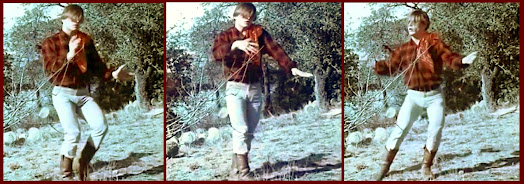
The shy one gets to strut his tight pants stuff...as he feels it


As one of the five homo cowboys, Little Joe managed to defy the Warhol Superstar imperative and convey a sense of interior self. Rumor at the time had it that Warhol was none to happy with the fact that Dallesandro was a talented screen presence, as is demonstrated in the convoluted spoof. Originally sixth-billed and with just a few scenes, Joe Dallesandro is more recently sold as the leading man. Whatever dislike Andy Warhol had for Joe didn't get in the way of making a buck off his back and it didn't matter anyhow: Warhol got shot, Paul Morrissey took over directing Warhol's movies and Morrissey loved Joe Dallesandro.


Joe joins the 60s...near the end of the 60's


   Flesh has its apparent genesis in  Midnight Cowboy's Joe Buck: the Warhol Superstars filmed cameos for that movie and Warhol got the jump on its most sensational aspect by getting Little Joe The Hustler into theaters well before his inspiration hit screens. But is he entirely informed by Mr. Buck? Joe Dallesandro probably should at least share writer's credit for Flesh - the lines he delivers with knowledge and conviction didn't jump off any page written by somebody else. 

Where Buck ends and Little Joe begins is of great consequence, since Joe Buck is a homophobe and Little Joe isn't. By the ripe old age of twenty Dallesandro plus alter-ego personified the hustler as male sex symbol, and it transpired to be not the niche and cheap personage which sexual repression still seeks to dismiss. For gender parity we need to look no further than an all-of-seventeen Alex Chilton fronting the Box Tops and urging "sweet cream ladies" to forward march, for all the right reasons. With genuine goodwill shared around, Little Joe may as well forward march as a sweet cream gent. 


Aspects of a well-rounded sex symbol

   The sweet cream of Joe Dallesandro isn't the topping on the bittersweet honesty that is 1968's Flesh - it's fundamental to its constitution and values. As an assembly of intelligent ideas fleshed out by Dallesandro's adroit performance, it significantly improves when set against its dirty and dishonest Hollywood nemesis: 1980's American Gigolo. The former challenges all men to look at the value of their body, as it challenges all men to look at the true value of heterosexuality, gendered roles and marriage as well. 

With male prostitution as the common motif, the latter merely seeks to wallpaper over presumed immorality, in the name of morality rammed home via "high class" hooking. While Flesh dwells on Dallesandro's body beyond prurient interests like those aroused by art and pornography, American Gigolo seeks to make a male sex symbol of Richard Gere via Armani-wear and an affirmation of heterosexuality...dubious scents of Italy having again wafted in to L.A. from 1961's dubious The Roman Spring Of Mrs. Stone. The amusing upshot of it all may very well be that Gere as an undressed store dummy has no sexuality whatsoever, and that's exactly what's being symbolized.


The hustle..."You gonna be home for a while David?"

If one's "basically straight" like Joe, then turning male tricks to make a living requires some earthy aptitude for the job...like being a man who enjoys sex. And if one's basically honest and not carrying a lot of homophobic baggage and contempt for other men, then his sexuality becomes naturally more fluid and rewarding by virtue of familiarity and connection with what he's doing. What's revolutionary to one may just be common sense to another. And it's a step backwards to carve up Little Joe The Hustler into two conflicting identities, as Gus van Sant did with 1991's My Own Private Idaho - as worthwhile as that movie is.


Substance rebirthed as fetish (see Note 3)
   As in "real life", love's lines, angles and rhymes often intrude when men's sexual transactions are financial. A john usually concludes with "I like you and I'd like to see you again" and rarely follows through. Hustlers often develop affection for men who do, and the moral dilemma of Flesh becomes crystal clear when David invites Joe to move in with him. Joe declines, but not for the reason of independence which another hustler might crave...Joe just says it wouldn't be right to abandon his marriage. 

No such thoughts are shared by his wife however, and on arriving home he finds out exactly how little weight his loyalty, his manhood and his heterosexuality carry around the place. Flesh is sometimes dismissed as "probably of more interest to the homosexual", but that probably says more about the shortcomings of those who'd say it.


Suppose They Had A Revolution And Nobody Could Get It Up?


 What's built up can be torn down, and iconoclasts will do their civic duty. Paul Morrissey, on behalf of Andy Warhol, decided his civic duty was to cinematically expand on his belief that junkies were human garbage...life's real trash. Whatever room they were reading it was a highly moralizing one, and not one remotely sympathetic to the Summer of Love. 

The opening shot of Little Joe's blotchy ass getting head isn't pornography unless a flaccid dick gets you going. Fellatio fails, as does some exhibitionism from the lady. The theme of Trash runs to little more than Joe not being able to get it up because he shoots heroin. It's not for a lack of ladies (trans, or otherwise) who only want a hard dick from him either: Joe's degradation as both man and sex symbol is repeated across the assembly of longish vignettes which comprise the movie.

Little is required of the viewer apart from having the ability to look down their nose at a sub-species of reviled humanity, while acquiring "insights" about dirty hippies. Joe Dallesandro's acting performance - improvising on ideas thrown to him - is as inspired as it gets. His deadpan spoilage is real, from dirty fingernails to filthy feet. His ritual cleansing (for a MMF three-way) is but a precursor to an overdose. Shot from above, his Christ-like helpless nakedness presages no redemption but instead disposal as garbage who won't get it up any time soon. 

Filmed over a few weekends, Trash has made gazillions and delights critics and audiences to this day, who insist it's a "black comedy".


Taking out the trash


Renamed Hollywood for Germany

   TIME called it "a faggot rehash of Sunset Boulevard", and few of the millions who've found joy in the seedy camp of Heat would passionately disagree. Norma Desmond was ripe for the picking since a desperate old drag queen sensibility permeates the original. Joe Dallesandro as Joe Davis subbing for Joe Gillis was a no-brainer: eye-popping buff, and with no visible means of support other than what he packs into a brief swimsuit there's little chance of him being mistaken for a struggling screenwriter.

Dallesandro's West Coast take on being a male sex symbol is one-part not initiating sex, and one-part delivering semi-satisfaction if opportunity presents itself...that is, leave 'em wanting more if they probably will. Again the dialog is improvised, and despite a battery of extreme close-ups which would betray insincerity in the best of trained actors, Joe's cards stay played mighty close to his chest. 

 A passive and essentially decorative man-boy apparently at the mercy of all manner of perversion plus sexual hysterics presented as female is a good jumping-off point for a campish Sunset Boulevard. But Heat is pure pharmacy-grade camp, and if one's familiar with a pool, a staircase and the spirit of Norma Desmond then Joey-three-times as male sex symbol is ready for his closeup. 


The alternative Joe Gillis: arriving from the pool and departing for the pool...with the clothes


Joe Dallesandro Is The Sexual Revolution

  Dallesandro's films with Warhol and Morrissey weren't the beginning and end of his career or his life, or indeed his contributions to revolutionary approaches to sex. (See note 4) He's had a long life as a working actor, and as an unusual man who's had a good life by his own account. It just so happened that a not-too-ordinary Joe being himself found himself as an extraordinary male embodiment of The Sexual Revolution, when few other males were able to connect with it or trust themselves with sex. Maybe all it takes is just keeping it simple and not defining it by an actor's pretentious self-absorption. Joe claims he "just showed up", but any East Coast boy knows that old one which goes "Eighty-percent of doing a good job is just showing up".


Kenn Duncan portrait 1968 (New York Public Library)


   The "when" of it all is critical: Joe's Warhol films arc from pre-Stonewall to a downturn of gay activism. For homos it was a counterculture men's movement opposing homophobia, and when the socialist left wanted nothing to do with Gay Lib, the movement wisely allied with feminists since it was always all about sex anyhow. The "when" can't be history's prisoner when the times still haven't caught up with Dallesandro - regardless of latter-day fashion editorial efforts.

While gay and bisexual men may have veered far from what the Sexual Revolution still embodies (and still falls short of achieving), Little Joe Dallesandro stands as a potent reminder that liberated men can happily swing whatever way they like and be unstudied cool while they're doing it. And he documented it all before the age of twenty-three - hardly a sexless artifact of Pop Art created by Andy Goddam Warhol.

Grainy old film of an adventurously non-threatening fine piece of ass who showed up and couldn't be bothered being homophobic? Yep, but isn't that enough to make a man a revolutionary and enduring sex symbol?


Notes:

1. "Hostility" is a relatively modern homophobic reaction which defies long-standing social norms i.e. society advantages good-looking young males, albeit in scattershot ways. Depending on his audacity and circumstances, an attractive male in his youth may be the first to intuit that homophobia is a superfluous luxury he can't afford, for both personal and professional reasons.                                                                                                                                                                                                                                                                             

2. The gay / trans-ploitation 'The Loves of Ondine' features 23 mins of dropped-in footage of Dallesandro wrestling Ondine in his underwear. /  He also appeared in the barely-released 'San Diego Surf ' - intended as a sequel to 'Lonesome Cowboys'.


3. In April 1971 'Rolling Stone' featured Dallesandro and son as its first non-musician cover boy. Superficially Contercultural, the lifestyle rag  for straight white boys was heavily influenced by the business of selling them straight white rock-and-roll. 

For three decades the industry cherry-picked homoerotic aspects of the Little Joe image and repurposed them for commercial gain and edgy but non-gay cred. The closest rock ever got was The Ramones' 1976  punk aka anti-rock celebration of turning male tricks, with "53rd & 3rd" being the New York spot where Joe wore down his shoe leather in 'Flesh'.

4. Banned and buried (and highly misrepresented) for decades, Serge Gainsbourg's wickedly subversive masterpiece 'Je t'aime moi non plus' (1976) hasn't been bettered in terms of outrages served while dispensing rough justice to the heart and soul of homophobia. Joe Dallesandro's Kras is one of those all-too-rare men in film - the inverted antihero, of the most superbly represented kind.


Thanks to:


  • Michael Ferguson's terrific biography - preview  HERE


Wednesday, July 14, 2021

Marco Berger's Men Who Tango


 "I don't make films for 'gay' audiences, but for the general public, where coincidentally the characters are men. I look at it from that place. I don't think about making films to be seen in a cinema or rented by 'gay' viewers, who go to 'gay' festivals. No, I do... a movie." - Argentinian Film Writer/Director, Marco Berger


   Now what's that we hear? That could very well come out of the mouth of any garden-variety queerbaiter who knows too well that pissy nods to "inclusion" and "representation" might up the box-office gross a few percentage points - courtesy of gay men starved of satisfying movie entertainment which actually dignifies them at some level. We've been falling for it for a very long time, and two decades into the twentieth century we're still being regularly served up as objects of pity and subjects of cartoon, with little or no self-determination and perpetually doomed to unhappy endings. "Heroic" and "males in cinema" mean virtually the same thing, and to a man we find find none are homosexuals or even homosexually-inclined. And as Hollywood was quick to learn, with deft screenwriting and editing you can purge any film of homo content for homophobic marketplaces.


But it's Marco Berger uttering the words, as he assumes the Presidency of La Asociación Argentina de Cineastas PCI in July 2021. And when Mr. Berger talks "men" we're wise to know that The Berger Shot is but one of his welcome and long-overdue contributions to modern cinema, as they relate to the male mystique. For a screenwriter and a director to be relegated to festivals or niche recognition can't be good enough if his vision is broad enough for the mainstream. As things stand right now, the mainstream has much to benefit from Marco Berger's cinematic offerings: homophobia is still peddled as the given default, with reinforced trauma as cinema's ongoing subliminal message. The genre seeks to justify itself as LGBT cinema verite while obscuring its origins as dubious contrived fiction.


We're not to know how much Berger's vision will be broadened, constricted or compromised to accommodate the masses. What we are to know is that over a relatively short career he's both prolific and a highly intelligent visionary when it comes to the subject of men. And he's probably been around long enough to deal with the static from Neo-Puritanism, as it's fomented in queerish communities around his own back door. 


The Pornography Of It All


   Down Argentine way (and for over a decade) Marco Berger's been not only representing but celebrating maleness onscreen in ways we've only ever seen in art. Or more specifically, maleness as feeling and sexual rather than of essentially political representation. And it would be grossly unfair to subject Berger to a diatribe about artistic gaze, or to assume his audiences aren't entirely responsible for their own reactions to something like male bulges in their faces and center-screen.


From the perspective of sexual politics, a gay director's habit of pointing out that men in general can be quite schizoid when it comes to bashfulness or boldness around their genitalia is a rather powerful statement of fact if not gay insight. Suffice to say that Berger regularly smashes cinematic narratives about men and maleness which are predicated on perpetuating male sexuality myths. Even if we're thinking of buying into a concept like "bromance" as a valid state of fully-formed male relationship then Marco Berger has a few scripts and many a crotch shot to remind us that it's probably not.


Cinema's worst-kept secret is probably that it can't keep up with pornography. The men who make both aren't all that different inasmuch as their product is targeted at audience demographics, with pornographers being just bold enough and progressive enough to not let their biases get in the way of a good show and making a buck. We can be relatively certain that Marco Berger isn't on a narrow mission as a gay pornographer or gay artiste since his homoerotic takes on male sensuality are quite appealing to female tastes. The long and the short of it is that girls like to see fellas making out, and doing it without force...like it just comes naturally. Or as we like to think Kinsey stated how it was and is a very long time ago.


While many gay men are ridiculously ensnared in fetishes about other men, imaginary and real, we might be tempted to think the same of Marco Berger. His camera dwells on male body parts and maleness long enough and regularly enough to arouse prurient interest. But it's only a device: for all the titillation the real "money shot" clearly is all about knowing the sweetness and humanity of the man you're looking at.


Marco Berger's Men As Originals


Taken as a whole, Pedro Almodovar's contributions to world cinema are quite encompassing. Known especially as a director who loves women enough to let them elevate themselves to unforgettable and unique personages on a screen, he's also no slouch when it comes to men from a Latin perspective. More influential than he's ever been given credit for, there's a strong case to be made for Almodovar passing a baton to Marco Berger. Clearly the latter loves men in a way that's not exclusively driven by a desire of the kind which comes with some misandry - Berger encourages us to like men as much as we desire them.


Like Almodovar's gays, Berger's men are matter-of-fact men for the most part. They're not usually defined by what they do for a living and refreshingly not struggling with "identity issues". Ignoring the easy ride of revisiting dubious American suburban middle-class neuroses while appropriately acknowledging internalized homophobia with a light touch, Marco Berger steps up to create men who hold our interest, and he does it with style and intelligence and then some. We gladly go to more introverted places with these guys, without being assaulted by extraneous events and contrived "action". Nor are the men contrived action figures of gym buff-ness and cosmetic enhancement: the bodies we peruse are worn by the men themselves, and not vice-versa.


Neither too young nor too old, the males Marco Berger present for us seem less actor-ish than even documentary subjects. Berger as auteur miraculously draws us into a circle of trust with his actors and does so at the paces of how life is truly lived. Berger's camera is unforgiving, his dialog is sparse and unsnappy and he's not relying on jump-cuts to sell what's counterfeit. In short, his men have to really act, and do it with body and soul. He makes it easy for us then to just be happy in the knowledge that the tango was originated by male couples, and watch three very sexy dances which might just take our breath away.


    Marco Berger’s much-loved debut feature is an arresting one for sure. A “caper” movie, it takes the time-worn Hollywood trope of faking gay to get what you want while consistently reinforcing heterosexuality as never before. Except Plan B goes exactly where the notion should have gone last century: Bruno’s hare-brained plan to win back his girlfriend from Pablo involves seducing him because he's heard that Pablo might swing both ways. We just know where Bruno’s pot-addled machinations might take him even if he doesn’t.


Bruno


The director’s well aware that much hinges on The Kiss…the thing that homophobia reviles more than actual male-on-male sex…with non-consenting being the more acceptable kind. Bruno of course hasn’t really thought things through at all, and after initiating a fast friendship with Pablo tests the waters by telling gal pal Ana that he and Pablo are now boyfriends. Ana demands that he kiss Pablo to prove it and the passionless peck convinces nobody at all. Plan B is failing: it’s obvious that Bruno isn’t sexually attracted to him at all.


Pablo


The moral of the story becomes apparent quite early: dig a hole for somebody and you’ll probably fall in it yourself. And so we’re enjoined to watch Cupid aim a big one at Bruno, and see the insincere seducer become the sincerely seduced. It’s in that state where it finally dawns on Bruno that a loving relationship of real value has grown in spite of himself. As the enemy of chastity, none but Cupid can take what has its genesis in deception and create that which we crave as truth.


Berger has us hooked to the point that we've completely forgotten that these two men are in essence not gay nor are they confused teens. Male humanity just seems to have overtaken identity, as well it should. We're quite aware that ineptitude reigns and honesty is in short supply. Calling time on a pretense of "just friends" to serve an essentially homophobic resolution just isn't good enough for two guys we've really come to like.


We like them and wish them well because they access our childlike part which often forgets but nevertheless holds to be truth. We know what true sweethearts are because we've all been compelled to partake in the rituals of gift-giving which communicate in ways that words just can't. Most importantly, we know what they need to do to seal the deal because we've seen enough of their bulges to know it's time to play grownups.


    While “tall, dark and handsome” may be a default of male sexual attraction as per Eurocentric sensibilities, something like the opposite applies to Latin machismo. A blond man reads as something else…something different. And onto that difference is projected both desirability and a tendency to sexual submission. No surprise then that Gabriel is introduced, identified and objectified as “the blond one” when Marco Berger takes on macho masculinities, and all that's inherent when machismo meets homosexual attraction.


The blond one...Gabriel / "Gabo"
The subject of fatherhood arcs The Blond One. “Gabo”, a widowed father himself, takes lodging in workmate Juan’s flat. The spartan room’s been vacated by Juan’s brother who’s knocked up his girlfriend, and it’s not long before the hyper-sexual Juan is sending signals – mixed or otherwise – of sexual availability to the passive and apparently introverted Gabo. The director locates them in a small apartment where breathing space is confined to watching television in the company of Juan’s heterosexual friends: a perfect set-up to pressure-cook the sexual tension that’s Marco Berger’s specialty.


The other one...Juan
Neither Gabo nor Juan appears to have any emotional intelligence whatsoever – be it good, bad or indifferent. They’re simply men and not boys. With no regard for “gay relationship” considerations, they’re soon screwing to the point that intimacy takes its natural course and demands to be addressed. As is usually the case in these serendipitous arrangements which fall like manna for men from time to time, homophobia intervenes in the form of Juan’s desires to pursue heterosexist imperatives.

It’s long been said that two men lack the glue to sustain a relationship, and despite 'the glue' never having been articulated for what it is there’s ample evidence that this is often the case. Of course it takes two to yield to what kills love, and Gabo lacks the balls to man up and assert his rightful place as the primary love partner of sorts. He’s revealed as having being gay all along, and it’s probably gay self-doubt which causes him to not protest too much when relegated to being just a fuck on the side. Some modicum of self-respect at the critical point where it mattered may have caused the blond one to bluntly state “Lose the female, amigo”, and stand his ground on that rock.

And it’s in not losing the female nearly soon enough that Juan loses everything. He too is on his way to unplanned fatherhood and it’s at the expense of all he has with Gabo. While we’re perhaps robbed of a happy ending for now, Marco Berger certainly isn’t stating that M2M relationships are doomed. The most reasonable takeaway from The Blond One is suggested by its coda: to the loving and open mind of a child, shame is just something very silly. 


    Corny romances about men and women of different classes falling in love are a predictable go-to, and often constructed as period pieces dressed up with lots of plummy dialog. The genre has never really explored or updated itself to the present...to serve two men. Yet such stories are probably most applicable to two men because a limited pool of available men necessitates abandoning class considerations if one's serious about finding love, or something like it.

So it's with all stops pulled out that Marco Berger launches high romance on an epic scale. Co-producer Pedro Irusta's elegant score slowly transports us to exposition - where the undying past lives in the present, as if in a bucolic dream. We find Eugenio ensconced in a rural old home as a bookishly attractive man living in silence.


Eugenio...a latter-day Lord of The Manor


Martin...the perhaps Itinerant  


By the time Martin shows up at the old house looking for summer work Berger's camera has made it obvious that two attractive and possibly lonely men are destined for an assignation, and probably one of exploitation - mutual or otherwise. Muddying those waters a whole lot more, it transpires Martin and Eugenio were boyhood friends a very long time ago. The apparently earnest Martin is not quite a drifter: despite his diminished circumstances he has plans for summer's end. He's just dropped back into the area looking to assemble a self he can live with from a fractured past, rather than seeking opportunity beyond survival.


Unsurprisingly, injury occurs near a bulge.


For Eugenio's part, the conflicts come thick and fast. His pragmatic uncle bluntly reminds him to think of what lies beyond a summer romance...this being high romance after all. While materially generous and kind, the respectful Eugenio can't or won't "take it to the next level", as he fails to read Martin's genuine tenderness. Or indeed even Martin's reference to pineapples. Marco Berger knows the score (and the stakes) well enough to not just throw them in the sack for some recreational fun. He also knows men well enough to restate the fact that few are able to negotiate mature relationship. Therein lies the tease.

Hawaii delivers by the bucketload: beautiful to experience and sexy enough to elevate a tired genre to superb entertainment of the classic kind. As it's intelligent enough to open newer and better pathways for men and women to think about men. 


The director saves the very best for last, and if we noticed the sweethearts' exchanges in Plan B we're again reassured by a View-Master that love has a past and a present, and a future if we choose to make it so. Why...it's even the same actor making apparently broken things work again, as Eugenio comes to know what "Hawaii" really means. When it comes to how to wind up a great story, Marco Berger's on the same page as Sam Shepard: "The most authentic endings are the ones which are already revolving towards another beginning".