Saturday, May 14, 2022

Gay Romance Movies: Too Niche Or Too Much Of A Threat?


"I inserted a gay romantic subtext" - Gore Vidal on 'Ben-Hur' (1959)


   Gay men experience a twice-removed relationship with movies. As both artform and persuasive social modeling, movies have traditionally defamed and excluded us, with what we pick up at the movies substantiating the Dhammapada's reference to herons by a lake with no fish...for a lifetime. What's been an endless banquet of approving acceptance for non-gay men is just sustained yearning and proscribed loneliness for the homo psyche. Hollywood certainly isn't stepping up to the plate as it excises token homo characters and scenarios in order to sell to flagrantly homo-hating global markets. Little good is likely to come from lucrative export product which may or may not pander locally to The American Dream, as filtered through the prisms of what commerce determines to be our just desserts.


   Forty years have come and gone since Vito Russo first published The Celluloid Closet. Groundbreaking in its focus and scope, it still clarifies how filmic culture best defames homosexuals – be they men who identify as gay, or men who simply like to have sex with other men. A co-founder of GLAAD, Russo’s work lives on as that U.S. organization’s benchmark criteria. The Vito Russo Test lucidly articulates how film-makers can best avoid their petticoats showing biased intent, and worse. The Test is necessarily applied consistently to all genres like drama, romance, comedy, and documentary.


· The film contains a character that is identifiably lesbian, gay, bisexual, and/or transgender (LGBT).

· That character must not be solely or predominantly defined by their sexual orientation or gender identity (i.e. the character is made up of the same sort of unique character traits commonly used to differentiate straight characters from one another).

· The LGBT character must be tied into the plot in such a way that their removal would have a significant effect. Meaning they are not there to simply provide colorful commentary, paint urban authenticity, or (perhaps most commonly) set up a punchline; the character should matter.


Cinema For Losers - The Parables Of Disingenuity


   Now, we’re almost twenty years into the Vito Russo Test guidelines, and as far as male characters go there’s little or no evidence that the guidelines are being implemented with any seriousness by film-makers. Or, more to the point, by American film-makers and their European counterparts. Seemingly, death and the misery of failed love are the normalized narratives for popular gay-themed mass entertainments – be they Philadelphia (1993), Brokeback Mountain (2005), or Call Me By Your Name (2017). The emptiness of Britain’s Weekend (2011) is no more sincere than Australia’s Holding The Man (2015), which sincerely believes its own lived-experience shallowness.


Like a sickly medication, the tropes of gay drama are relentlessly regurgitated as menace and struggle, with gained 'resilience' ostensibly the best payoff imaginable. Awards and rewards flow, with few asking whether or not the underlying takeaway of 'Toughen up, princess' is nearly enough when few practical ideas like a punching bag ('Cuatro Lunas', Mexico (2014)) or a rifle ('Marilyn', Argentina (2018)) are offered up as ways princesses might toughen up, rather than sucking it up. It's hard to dispute that Moonlight (2016) isn't just more of the Stateside same as it applies to the filmed male homosexual experience. While female gaze upon the male body is notionally welcome, sitting through writer / director Eliza Hittman's sordid 'Beach Rats' (2017) just might be cause to hope she never does it again, and that critics and film festivals alike stop celebrating dated soulless junk about men who have sex with other men.


In a shorthand media age it's hard to avoid lists, and the prolific '50 Best LGBT / Queer Films' lists are far more suspect than their daffy nods to community and inclusion imply: as a recently-created genre of the socially constructed kind it first needs to be evaluated for soft-sold multi-group segregation intent. By the time one's eliminated what has nothing to do with men loving men or men who've actually 'come of age', the leftovers are for the most part formulaic and anti-progressive. We're reminded that neither Gregg Araki nor Gus van Zant has been able to deliver the contemporary gay male masterpiece expected of New Queer Cinema, let alone it having found form as a seductive romance...where somebody actually gets the guy with no suffering involved. You just know segregation's alive and well when two men who attractively hit it off rarely appear in 'mainstream' movies of any genre - even as secondary or support characters.


The Wheel of Misfortune - step right up fellas!  
 
 
It’s not naïve or unrealistic to expect happy endings, and when cinema consistently delivers the opposite we’re wise to suspect all that hides behind quasi-documentary struggles lest we're giving a pass to perpetuating victimhood. It's worth noting that both Brokeback and Call Me... feature photogenic locales which serve to numb what's most unattractive and pleasureless about their storylines. It's also worth noting that with some goodwill and ingenuity the device can be purposed to support uplifting stories about diverse men who elevate the romance genre to its rightfully gratifying and most powerful place.


We're probably all hard-wired to crave at least two of the three components of romance: attraction, lust and attachment. The genre of romance in media embellishes it all with chivalry and what's seductive about faraway places and men with strange-sounding names. Our healthiest selves always anticipate a future which may have little to do with what we have now, and there's nothing quite like a romance movie to get the dopamine cells firing...why, it's almost like being in love.


Some Speak Of 'Journeys'...


   It's not that North America can't make excellent and deeply satisfying gay romance movies - it seems the continent just won't. A notable exception is Yen Tan's Pit Stop (2013). This slice of pure Americana about two purely American sweethearts of men who've been hurt by love very quickly accesses our better selves as we wait in suspense for what must surely be their destined assignation. Ernesto and Gabe have problems 'moving on': they're not gay extroverts given to such dubious journeys. The dark hand of LGBTQ media politics is entirely absent from Pit Stop, as evidenced by no cliches of tragedy and identity. Director Tan drip-feeds us these fellas with everything but cheap gay chemistry. And as with the best of romance, we're seduced by thoughts that deserved love really comes to those who deserve it. 


Reviewers and commentators alike are thrown by The Man With The Answers (2021), with quite a few not knowing what to make of a male romance which fails to spell out 'sexual identity' (or even career identity, for that matter) on its calling card. With no obvious dramatic precipitations to justify itself, writer / director Stelios Kammitsis' road movie is most European, as its men are most matter-of-fact. Its allure lies in that sweet spot where the mundane plays against sumptuous scenery, magnificently photographed. Too short at around 80 minutes, the road of trust and seduction Victoras and Matthias take is clunkier than the old Audi they're in but both are eminently serviceable ways to get from A to B.


Do we know who's driving or where we're going to?

One would expect the movie to stumble somewhere (or everywhere) on its cliches but it's so well directed and acted that you want the trip to not end so soon. Kammitsis certainly has his ducks lined up, and knows exactly where a gay relationship stands in the grand scheme of things.



Washing their sins away...or something
 

The Man With The Answers can be experienced as counterpoint to - or refreshment - from He Loves Me (2018). Writer / director Konstantinos Menelaou's voice-over'd rumination about two very gay men taking their very urban crumbling relationship to a deserted beach to re-find love in the dunes (and in the raw) is as confronting as it is self-indulgent.


As a bitter indictment of many gay relationships, He Loves Me very much presents the relationship Marianne Williamson ascribes to two emotional cripples joined at the hip. The film hasn't found many gay fans beyond the soft-core porn crowd and that's remarkable because it's not unrelated to the celebrated Weekend (2011), which conclusively proved that gay men can talk shit with the best of 'em when it comes to relationships. A peculiar and uncomfortable film, He Loves Me goes directly to where we angels fear to tread: damaged men and interpersonal dysfunction, as pressure-cooked by an urban gay lifestyle. It's probably a fine romance, of the been-around-the-block kind.


 It's A Big Wide World 


    There's a lot to bemoan when we're enslaved to our own cultural presumptions. Thankfully there's much to experience and enjoy when we're not. My own comfort zone suits me best when it's inhabited by men just like me as well as men not like me at all. Along those lines, if travel broadens one's horizons then cinema can do the next best thing - especially if it's directly sex-positive as our culture becomes less so.

It hadn't occurred to me that I'd never seen a homo onscreen who was just like me until very recently. And I was completely overwhelmed when it happened: Alec Secăreanu's take on Gheorghe in God's Own Country (2017) seemed ripped from my soul and the sense of validation I experienced was life-affirming in a way that many ideas I had about identity and being a gay outsider melted away. Such is the power of cinema, and the British movie uplifted me in ways that a dozen of the finest academic writings (or self-help books) about homosexuality never could.


Gheorghe and his Johnny..quite simply, for better and for worse. 


An exceptionally well-made first feature by Francis Lee, it's magic is propelled by its earthy connection to nature in an alternately beautiful and hard landscape requiring some knockout acting to match: these guys actually do something besides living in their heads and immersing themselves in the inorganic. They farm. They adapt. They live, they love. The heart of God's Own Country just might be as simple as chances taken and given are their own rewards.


The passion and the pride of Antonio & Lucas
  
The day movie theaters closed in 2019 at the onset of this century's pandemic was the proposed opening day for Chilean writer / director Omar Zúñiga Hidalgo's Los Fuertes but that misfortune is balanced by the fact that it's been generally widely available. Probably too short and positively crying out for a sequel, it takes its own sweet and sexy time to get to the point: at what age does a man need to crunch the numbers and think twice about leaving the apparently perfect man in the far regions to pursue urban gay ambitions? And of course there's the question of how the fisherman who's being left behind is supposed to feel when neither man is a callow college boy.

In substituting an almost end-of-the-world landscape for societal menace, Hidalgo elevates his story of men who love into a film of rare observational intelligence which isn't chasing such an honor.


    Argentina is a home-base of sorts for gay male films these day - due in no small part to the prolific output and sensually arresting films of Marco Berger. Lessons have been learned from Spain's Almodovar - that gay genius film-maker has never subjected a character to 'coming out' over four decades, or even thought that audiences needed to share such a ritual. Perhaps just dash a of hot-blodded male arrogance with its heart on its sleeve is all it takes for some men to refuse to build or refurbish their own closets.

From the pen of Andi Nachon, director / producer Papu Curotto deftly crosses a few borders (and some might say boundaries) with Beyond Borders: Esteros (2016). The nominal wetland estuaries refer to both the regional setting in Argentina's far North East and what happens when fresh water meets salty sea. Or male romance within an ecological allegory if you like. Matías and Jerónimo were childhood friends who developed a mutual, pubescent sexual attraction prior to the former's family relocating across the border to Brazil. Predictably, a decade later they re-meet by chance - with Jerónimo as a single but secure gay man while Matías is ensconced in a relationship with a woman.

Not waiting for Grindr to sound


What presents as a predictable bittersweet pill for gays to swallow isn't what Curotto has in mind at all: Jerónimo is well and truly out, not inclined to subservience to heterosexual imperatives, resents having been apparently 'cancelled' by Matías and is quick to remind him that he was indeed Matías' 'first' when it comes to sex. The delightful payoff is exactly what it should be for any man willing to take charge of his life and loves.


But that's not all. It would be remiss to not re-mention two remarkable Brazilian features which transcend the dubious trappings of youth-themed coming out epics: The Way He Looks (2014) and Hard Paint (2018). While they may not enchant us by appealing to our stereotypical instincts to form an attachment of desire to one or both of the male leads, we're hard-pressed to not think about falling in love with somebody far removed from our normalized urban Prince Charming fantasies.


It's Only A Movie

 
   Or is it? Vito Russo concluded The Celluloid Closet all those years ago with a special mention for all the queers who work in Hollywood, in the full knowledge that powerful Hollywood product was, and still is, insulting to great degrees. Those who consistently choose to remain silent, regardless of how much power they wield, have newer faces but but are of the same old politics. We may have been lulled into thinking that things have changed, but what exactly has changed when high-minded awards and critical praise are handed out for the mawkishness of 'coming through adversity'...with just enough menace to subliminally keep victims as victims?

However, as we've seen - and going with relatively narrow but informative criteria - film-makers are making films which dignify gay men doing what gay men can do, while standing as excellent and original films in their own right for all audiences. Remarkably diverse (although not significantly diverse when it comes to class or race), they're the results of our broader worldwide communities committing to that muse that is the cinema. New auteurs are exploiting newer ways to bring their visions to the world, be it by streaming services, crowdfunding and even giving their art away for free. Usually years in gestation, they're often preceded by shoestring-budgeted short films to drum up interest. We're wise to know that something based on a true story doesn't legitimize it: assumed gravitas shouldn't be mistaken for truth or art or satisfying entertainment.


And then again, if art just reflects life it's not too much to ask that the cinema now and then reflects a life well-lived i.e. a life which knows that there's only love and fear, and that they can't co-exist.


Friday, December 31, 2021

The Sexual Revolution Is Joe Dallesandro


"A wonderful actor who forever changed male sexuality in cinema." 

 John Waters


   The man doesn't lie. Mr Waters is merely stating what's factual and obvious. And in the half-century that's ensued, the males who've stripped full-frontal naked in the sex symbol's modern breeding ground have, to a man, failed to emulate the male sex symbol that Joe Dallesandro was, an is. The camera probably reads subliminal full-frontal shame for what it is: for all the filmed frou-frou and prosthetic dicks there's been remarkably little male sexuality to see and experience when the movie house lights go dim. And Western civilization has form when it comes to purposing male nudity for political and ideological ends, via all forms of artistic expression. 


This Male Sex Symbol Thing

   He's had a checkered history. From the amulets of antiquity with huge erections to whatever any society purposes him for...be it breeding superiority, war, rape or psychological war on other males. That's a created sex symbol, and be it baked clay or the polished plastic of Chippendale's burlesque, it's existence is medium-dependent. Somebody, somewhere always seeks to manipulate the public imagination via medium messaging, and cinema may very well be the worst offender inasmuch as it thinks a "stud" is a male sex symbol. Despite that turd of an idea flying in the face of the facts, it's a turd which Hollywood especially, on behalf of heterosexuality, won't stop polishing.

Valentino vs Puritanism,1921
And then there's the male sex symbol which just happens, and he's sensational. Valentino towers over the rest because he's a collection of ideas and qualities which found form as filmed mass entertainment. He's bigger than his pictures because his sex appeal is experienced at head-meets-groin level by men and women, en masse.

 That's problematic for a society which opposes men finding other men sexually attractive, symbolically or otherwise. Problematically also is the fact that the male sex symbol in cinema had never been what's expected of a female sex symbol: an alluring easy-going piece of non-aggresive pulchritude for gratifying exploitation in the mind of his consumer, or customer.

And it's into that void that Joe Dallesandro strode as a one-man sexual revolution: naked as a jaybird, and looking just as good from the front as the rear.


Evolution: Where Does A Sex Symbol Come From?

   Dallesandro himself offers a tantalizing clue: "I guess I was looking for some kind of father figure". It's quite revelatory inasmuch as it refers to his teenage location as a runaway in California, notably documented by homoerotic images, across quite a few years. His biographer Michael Ferguson doesn't dwell on the demi monde details of this time but Dallesandro clarifies that something transformative happened for him when being exposed to gay men, as his desirability came with their acceptance of who he was. While Lou Reed states that "Little Joe never once gave it away...everybody had to pay and pay", we can never be certain that the transactions men make amongst themselves are as shallow or as deep as we imagine.

The homosexual male gaze can't legitimately be presumed as offensive or damaging to a young man. For many it's expected, welcomed or met with hostility in varying degrees - especially if he's good-looking. (see note 1) For Joe Dallesandro it was a healthy affirmation of his sexual manhood and it didn't arouse residual homophobia. A homecoming of sorts, it was the end of a road plagued by acting out, and a road once seemingly headed to a lesser life of crime and violence. Lacking in stability and social stature and standing at a belligerent 5'6", Joe wasn't the kind of guy you'd put money on to win at The American Dream circa 1964. In fact, his working-class response was to look back at it: his action plan involved building a 1950's body around his 1940's sensibility tattoo which had proclaimed "Little Joe" from age 15. 

Too young to have developed the hard mass musculature of the many other Italian American bodybuilder guys who peopled California's "modeling" world, the camera disclosed something else quite remarkable: another male with the harmonious proportions of antiquity's statuary. As photographed by greats like Bob Mizer and Bruce of Los Angeles, Joe Dallesandro usually went by his own name when many didn't. Only time would tell whether he was a young naif or a man with enough agency to gladly let others write their own stories on the image of his body. While he's often quoted as retrospectively not being comfortable with being filmed nude he's rarely given his last word: self-approving braggadocio it seems went a long way to ameliorating discomfort. 


A Hustle Here And A Hustle There...


   By 1967, the "there" was back in New York City, and at nineteen Joe Dallesandro had three Underground films under his belt. (see Note 2). He'd abandoned his father-identified image and now presented as youngish and contemporary, with a body less cut and looking more fashionably natural. The greasy pompadour of his feigned adulthood was gone. While Dallesandro is undeniably the greatest of Andy Warhol's underground Superstars because of his artistic output, cultural influence and commercial value, we're reminded that he was of the Counterculture as well, and that he was most importantly of the Sexual Revolution and squarely in the liberationist category.

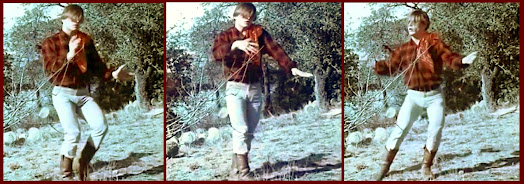
With Lonesome Cowboys, director Warhol was canny enough and underground enough to homosexualize that bastion of red-blooded male propaganda - the Western. And he really homosexualized it in not exhibiting cowboy pansies for laughs or pity in the cheap seats - he threw Gay Lib a bone of no small significance while rattling the floorboards of American mythology. Lonesome Cowboys riffs on themes of family and brotherhood as community, whereas the mainstream would be served up freak shows and self-loathing epics like The Boys In The Band as sorta-documentary entertainments for a very long time. 


The shy one gets to strut his tight pants stuff...as he feels it


As one of the five homo cowboys, Little Joe managed to defy the Warhol Superstar imperative and convey a sense of interior self. Rumor at the time had it that Warhol was none to happy with the fact that Dallesandro was a talented screen presence, as is demonstrated in the convoluted spoof. Originally sixth-billed and with just a few scenes, Joe Dallesandro is more recently sold as the leading man. Whatever dislike Andy Warhol had for Joe didn't get in the way of making a buck off his back and it didn't matter anyhow: Warhol got shot, Paul Morrissey took over directing Warhol's movies and Morrissey loved Joe Dallesandro.


Joe joins the 60s...near the end of the 60's


   Flesh has its apparent genesis in  Midnight Cowboy's Joe Buck: the Warhol Superstars filmed cameos for that movie and Warhol got the jump on its most sensational aspect by getting Little Joe The Hustler into theaters well before his inspiration hit screens. But is he entirely informed by Mr. Buck? Joe Dallesandro probably should at least share writer's credit for Flesh - the lines he delivers with knowledge and conviction didn't jump off any page written by somebody else. 

Where Buck ends and Little Joe begins is of great consequence, since Joe Buck is a homophobe and Little Joe isn't. By the ripe old age of twenty Dallesandro plus alter-ego personified the hustler as male sex symbol, and it transpired to be not the niche and cheap personage which sexual repression still seeks to dismiss. For gender parity we need to look no further than an all-of-seventeen Alex Chilton fronting the Box Tops and urging "sweet cream ladies" to forward march, for all the right reasons. With genuine goodwill shared around, Little Joe may as well forward march as a sweet cream gent. 


Aspects of a well-rounded sex symbol

   The sweet cream of Joe Dallesandro isn't the topping on the bittersweet honesty that is 1968's Flesh - it's fundamental to its constitution and values. As an assembly of intelligent ideas fleshed out by Dallesandro's adroit performance, it significantly improves when set against its dirty and dishonest Hollywood nemesis: 1980's American Gigolo. The former challenges all men to look at the value of their body, as it challenges all men to look at the true value of heterosexuality, gendered roles and marriage as well. 

With male prostitution as the common motif, the latter merely seeks to wallpaper over presumed immorality, in the name of morality rammed home via "high class" hooking. While Flesh dwells on Dallesandro's body beyond prurient interests like those aroused by art and pornography, American Gigolo seeks to make a male sex symbol of Richard Gere via Armani-wear and an affirmation of heterosexuality...dubious scents of Italy having again wafted in to L.A. from 1961's dubious The Roman Spring Of Mrs. Stone. The amusing upshot of it all may very well be that Gere as an undressed store dummy has no sexuality whatsoever, and that's exactly what's being symbolized.


The hustle..."You gonna be home for a while David?"

If one's "basically straight" like Joe, then turning male tricks to make a living requires some earthy aptitude for the job...like being a man who enjoys sex. And if one's basically honest and not carrying a lot of homophobic baggage and contempt for other men, then his sexuality becomes naturally more fluid and rewarding by virtue of familiarity and connection with what he's doing. What's revolutionary to one may just be common sense to another. And it's a step backwards to carve up Little Joe The Hustler into two conflicting identities, as Gus van Sant did with 1991's My Own Private Idaho - as worthwhile as that movie is.


Substance rebirthed as fetish (see Note 3)
   As in "real life", love's lines, angles and rhymes often intrude when men's sexual transactions are financial. A john usually concludes with "I like you and I'd like to see you again" and rarely follows through. Hustlers often develop affection for men who do, and the moral dilemma of Flesh becomes crystal clear when David invites Joe to move in with him. Joe declines, but not for the reason of independence which another hustler might crave...Joe just says it wouldn't be right to abandon his marriage. 

No such thoughts are shared by his wife however, and on arriving home he finds out exactly how little weight his loyalty, his manhood and his heterosexuality carry around the place. Flesh is sometimes dismissed as "probably of more interest to the homosexual", but that probably says more about the shortcomings of those who'd say it.


Suppose They Had A Revolution And Nobody Could Get It Up?


 What's built up can be torn down, and iconoclasts will do their civic duty. Paul Morrissey, on behalf of Andy Warhol, decided his civic duty was to cinematically expand on his belief that junkies were human garbage...life's real trash. Whatever room they were reading it was a highly moralizing one, and not one remotely sympathetic to the Summer of Love. 

The opening shot of Little Joe's blotchy ass getting head isn't pornography unless a flaccid dick gets you going. Fellatio fails, as does some exhibitionism from the lady. The theme of Trash runs to little more than Joe not being able to get it up because he shoots heroin. It's not for a lack of ladies (trans, or otherwise) who only want a hard dick from him either: Joe's degradation as both man and sex symbol is repeated across the assembly of longish vignettes which comprise the movie.

Little is required of the viewer apart from having the ability to look down their nose at a sub-species of reviled humanity, while acquiring "insights" about dirty hippies. Joe Dallesandro's acting performance - improvising on ideas thrown to him - is as inspired as it gets. His deadpan spoilage is real, from dirty fingernails to filthy feet. His ritual cleansing (for a MMF three-way) is but a precursor to an overdose. Shot from above, his Christ-like helpless nakedness presages no redemption but instead disposal as garbage who won't get it up any time soon. 

Filmed over a few weekends, Trash has made gazillions and delights critics and audiences to this day, who insist it's a "black comedy".


Taking out the trash


Renamed Hollywood for Germany

   TIME called it "a faggot rehash of Sunset Boulevard", and few of the millions who've found joy in the seedy camp of Heat would passionately disagree. Norma Desmond was ripe for the picking since a desperate old drag queen sensibility permeates the original. Joe Dallesandro as Joe Davis subbing for Joe Gillis was a no-brainer: eye-popping buff, and with no visible means of support other than what he packs into a brief swimsuit there's little chance of him being mistaken for a struggling screenwriter.

Dallesandro's West Coast take on being a male sex symbol is one-part not initiating sex, and one-part delivering semi-satisfaction if opportunity presents itself...that is, leave 'em wanting more if they probably will. Again the dialog is improvised, and despite a battery of extreme close-ups which would betray insincerity in the best of trained actors, Joe's cards stay played mighty close to his chest. 

 A passive and essentially decorative man-boy apparently at the mercy of all manner of perversion plus sexual hysterics presented as female is a good jumping-off point for a campish Sunset Boulevard. But Heat is pure pharmacy-grade camp, and if one's familiar with a pool, a staircase and the spirit of Norma Desmond then Joey-three-times as male sex symbol is ready for his closeup. 


The alternative Joe Gillis: arriving from the pool and departing for the pool...with the clothes


Joe Dallesandro Is The Sexual Revolution

  Dallesandro's films with Warhol and Morrissey weren't the beginning and end of his career or his life, or indeed his contributions to revolutionary approaches to sex. (See note 4) He's had a long life as a working actor, and as an unusual man who's had a good life by his own account. It just so happened that a not-too-ordinary Joe being himself found himself as an extraordinary male embodiment of The Sexual Revolution, when few other males were able to connect with it or trust themselves with sex. Maybe all it takes is just keeping it simple and not defining it by an actor's pretentious self-absorption. Joe claims he "just showed up", but any East Coast boy knows that old one which goes "Eighty-percent of doing a good job is just showing up".


Kenn Duncan portrait 1968 (New York Public Library)


   The "when" of it all is critical: Joe's Warhol films arc from pre-Stonewall to a downturn of gay activism. For homos it was a counterculture men's movement opposing homophobia, and when the socialist left wanted nothing to do with Gay Lib, the movement wisely allied with feminists since it was always all about sex anyhow. The "when" can't be history's prisoner when the times still haven't caught up with Dallesandro - regardless of latter-day fashion editorial efforts.

While gay and bisexual men may have veered far from what the Sexual Revolution still embodies (and still falls short of achieving), Little Joe Dallesandro stands as a potent reminder that liberated men can happily swing whatever way they like and be unstudied cool while they're doing it. And he documented it all before the age of twenty-three - hardly a sexless artifact of Pop Art created by Andy Goddam Warhol.

Grainy old film of an adventurously non-threatening fine piece of ass who showed up and couldn't be bothered being homophobic? Yep, but isn't that enough to make a man a revolutionary and enduring sex symbol?


Notes:

1. "Hostility" is a relatively modern homophobic reaction which defies long-standing social norms i.e. society advantages good-looking young males, albeit in scattershot ways. Depending on his audacity and circumstances, an attractive male in his youth may be the first to intuit that homophobia is a superfluous luxury he can't afford, for both personal and professional reasons.                                                                                                                                                                                                                                                                             

2. The gay / trans-ploitation 'The Loves of Ondine' features 23 mins of dropped-in footage of Dallesandro wrestling Ondine in his underwear. /  He also appeared in the barely-released 'San Diego Surf ' - intended as a sequel to 'Lonesome Cowboys'.


3. In April 1971 'Rolling Stone' featured Dallesandro and son as its first non-musician cover boy. Superficially Contercultural, the lifestyle rag  for straight white boys was heavily influenced by the business of selling them straight white rock-and-roll. 

For three decades the industry cherry-picked homoerotic aspects of the Little Joe image and repurposed them for commercial gain and edgy but non-gay cred. The closest rock ever got was The Ramones' 1976  punk aka anti-rock celebration of turning male tricks, with "53rd & 3rd" being the New York spot where Joe wore down his shoe leather in 'Flesh'.

4. Banned and buried (and highly misrepresented) for decades, Serge Gainsbourg's wickedly subversive masterpiece 'Je t'aime moi non plus' (1976) hasn't been bettered in terms of outrages served while dispensing rough justice to the heart and soul of homophobia. Joe Dallesandro's Kras is one of those all-too-rare men in film - the inverted antihero, of the most superbly represented kind.


Thanks to:


  • Michael Ferguson's terrific biography - preview  HERE